Intercooler Failure: Symptoms, Causes and When ECU Tuning Can Help
An intercooler failure on a diesel or turbocharged petrol car causes a notable drop in performance — and it can be misdiagnosed. Understanding what an intercooler does, how to spot the warning signs, and whether ECU recalibration plays a role can save you from an unnecessary repair bill.
Diesel engine diagnosis
Turbo boost issues
ECU fault solutions
Jump to a section
What does an intercooler do?
A turbocharger compresses air before it enters the engine. Compressed air gets hot — and hot air is less dense, which means less oxygen per charge and reduced combustion efficiency. The intercooler sits between the turbocharger and the intake manifold and cools that compressed air before it reaches the engine.
A well-functioning intercooler allows the engine to run a denser, cooler air charge — which supports higher boost pressure, better combustion, and more power. When the intercooler fails or leaks, the engine loses cooling efficiency and power drops accordingly.
Air-to-air vs air-to-water intercoolers
Most diesel and turbocharged petrol cars use air-to-air intercoolers mounted at the front of the car. Some performance and newer vehicles use air-to-water systems. The failure symptoms are similar in both cases, though the location and repair process differ.
Common intercooler failure symptoms
An intercooler problem usually presents gradually rather than as a sudden failure. The signs to watch for include:
- Loss of power: The most consistent symptom. The engine feels less responsive, especially under load or during acceleration. The turbo may spool up but the power doesn’t follow through.
- Increased fuel consumption: A poorly cooled air charge means the engine needs more fuel to produce the same output. Noticeable drops in MPG are common.
- Smoke from the exhaust: If oil is entering the intercooler through a worn turbo seal, it can reach the combustion chamber and produce blue or greyish smoke from the exhaust.
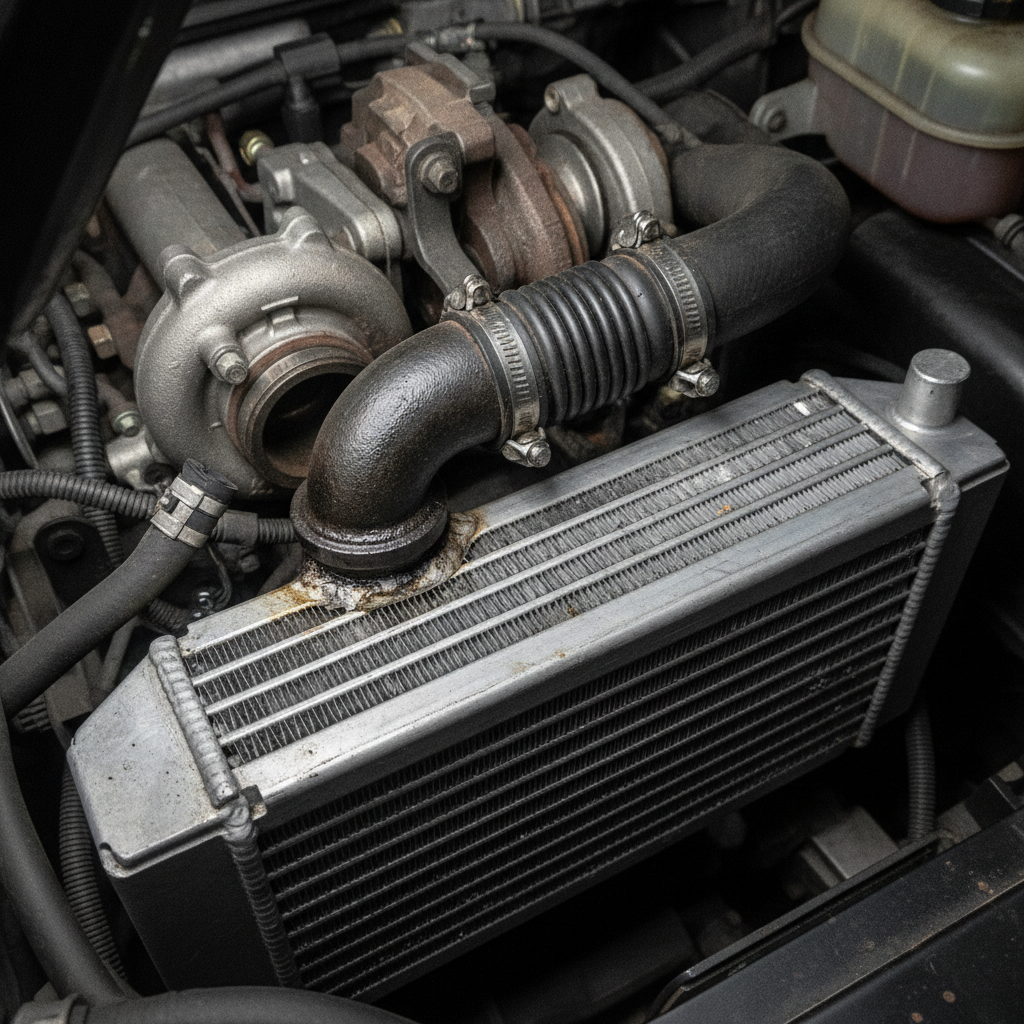
- Oil residue around boost hoses: Visible oily residue around the intercooler inlet pipe, the hoses, or the boost pipe connections is a key indicator of oil passing through the system.
- Boost pressure faults: The engine management system monitors boost pressure. If the pressure reading drops or fluctuates, a fault code is triggered and the check engine light may appear.
- Overheating under load: A leaking intercooler allows hot, uncontrolled air into the intake — raising intake temperatures and in some cases triggering thermal protection.
- Rough idle: Unmetered air entering through a cracked intercooler or loose boost hose disrupts the air-fuel ratio and can cause rough running at idle.
Why intercoolers fail
Intercooler failures fall into a few main categories:
Physical damage
Stone chips, road debris, and minor front-end impacts can damage the intercooler matrix — particularly on front-mounted units. Small perforations may cause a slow boost leak that only shows up under load.
Hose and clamp failure
The boost hoses connecting the intercooler to the turbo and intake manifold are a common failure point. Rubber hoses deteriorate with age and heat cycling. Clamps can work loose over time. A split or disconnected boost hose produces symptoms very similar to intercooler failure itself — large power loss and boost pressure faults.
Internal oil contamination
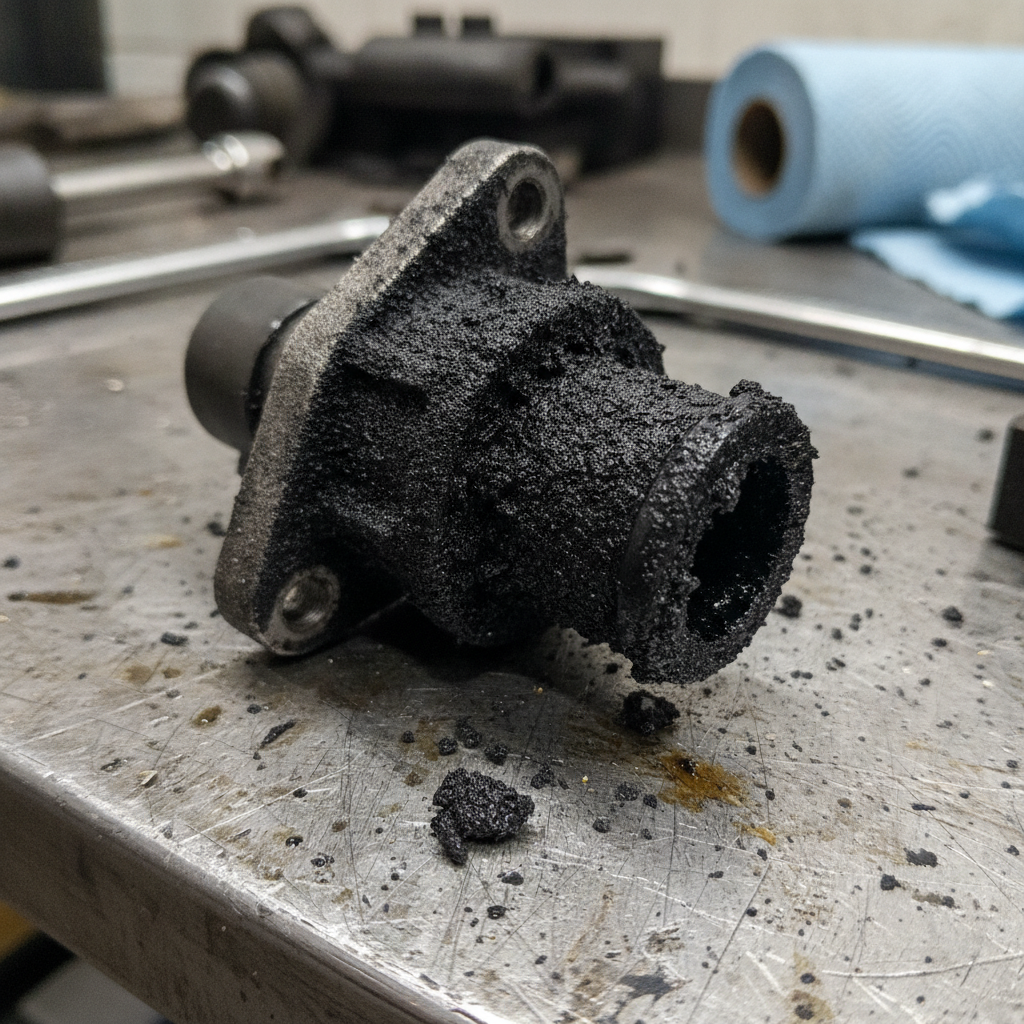
When the turbocharger’s seals wear, oil passes through the compressor side and into the intercooler. Over time, oil accumulates in the core and reduces cooling efficiency. This also results in oily residue visible at the intercooler outlet and can contribute to intake deposit build-up downstream.
Core degradation
On higher-mileage vehicles, the intercooler core itself can crack internally due to repeated thermal expansion and contraction. This is more common after many years of use and is harder to diagnose without a dedicated boost test.
Don’t confuse intercooler and turbo failure
Intercooler symptoms and turbocharger failure symptoms overlap heavily. Power loss, smoke, and boost faults can come from either component. Diagnosing the root cause correctly before replacing parts is essential — replacing an intercooler when the turbo is the real problem leaves the underlying issue in place.
How to diagnose an intercooler fault
A proper diagnosis involves more than a visual inspection:
- Boost pressure test: A smoke machine or pressure test through the intake system will reveal leaks in the intercooler, hoses, or connections. This is the most reliable method for finding boost leaks.
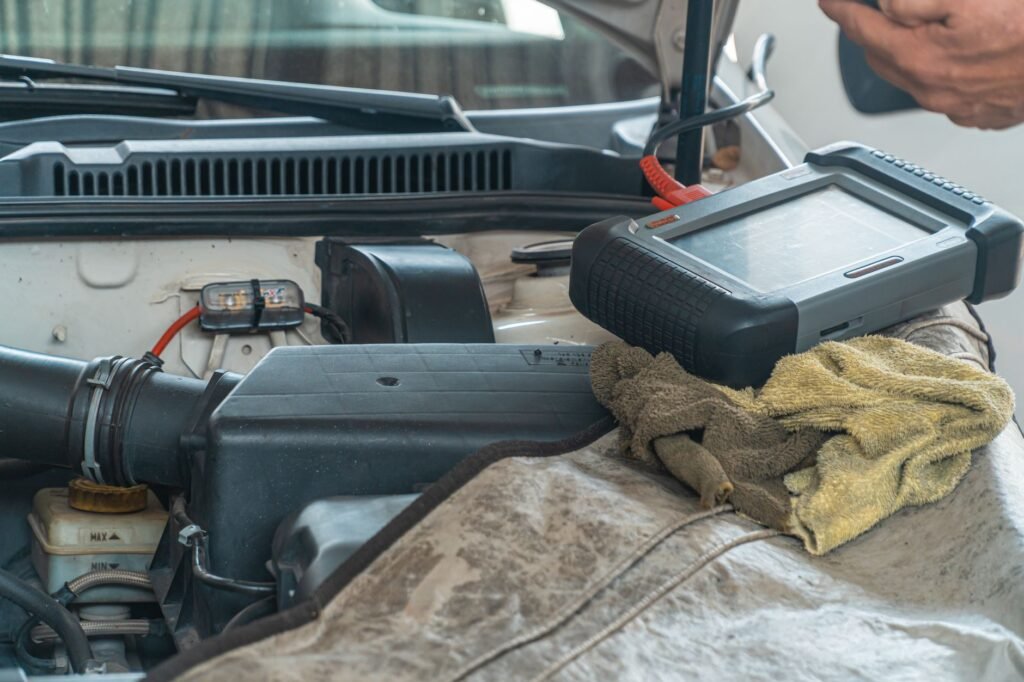
- OBD diagnostic scan: Read fault codes related to boost pressure (common codes: P0299 — boost underperformance; P0087 — fuel pressure related to fuelling adjustments from low boost). These codes don’t identify the intercooler directly, but they point to the boost circuit as the problem area.
- Visual inspection: Check all boost hoses for splits, cracks, and loose clamps. Check around the intercooler inlet and outlet for oil residue.
- Boost log under load: A live data log of boost pressure during a test drive under load can reveal whether actual boost is tracking the target boost. A significant gap suggests a leak.
Intercooler failure and limp mode
When the engine management system detects boost pressure consistently below target, it may enter limp mode to protect the engine. In limp mode, the turbo boost is significantly reduced and power is heavily restricted — you may be limited to below 60 mph or find the engine refuses to rev beyond a certain point.
Limp mode triggered by a boost leak is one of the more common misdiagnoses on turbocharged diesels. Drivers often assume a turbo failure and prepare for an expensive repair when the actual fault is a cracked boost hose or a leaking intercooler that can be replaced at much lower cost.
When ECU tuning is part of the picture
ECU remapping is not a fix for a mechanically failed intercooler. If the core is cracked or a hose is split, those physical issues need to be resolved first. However, there are scenarios where ECU calibration is relevant to intercooler-related problems:
Post-repair recalibration
If a faulty intercooler has been causing the engine management system to adapt its fuelling and boost maps over time (a process called adaptive learning), these adaptations may need resetting after the repair. In some cases, a recalibration of the boost and fuelling parameters ensures the engine runs cleanly after the mechanical fix.
Intercooler upgrade and remap
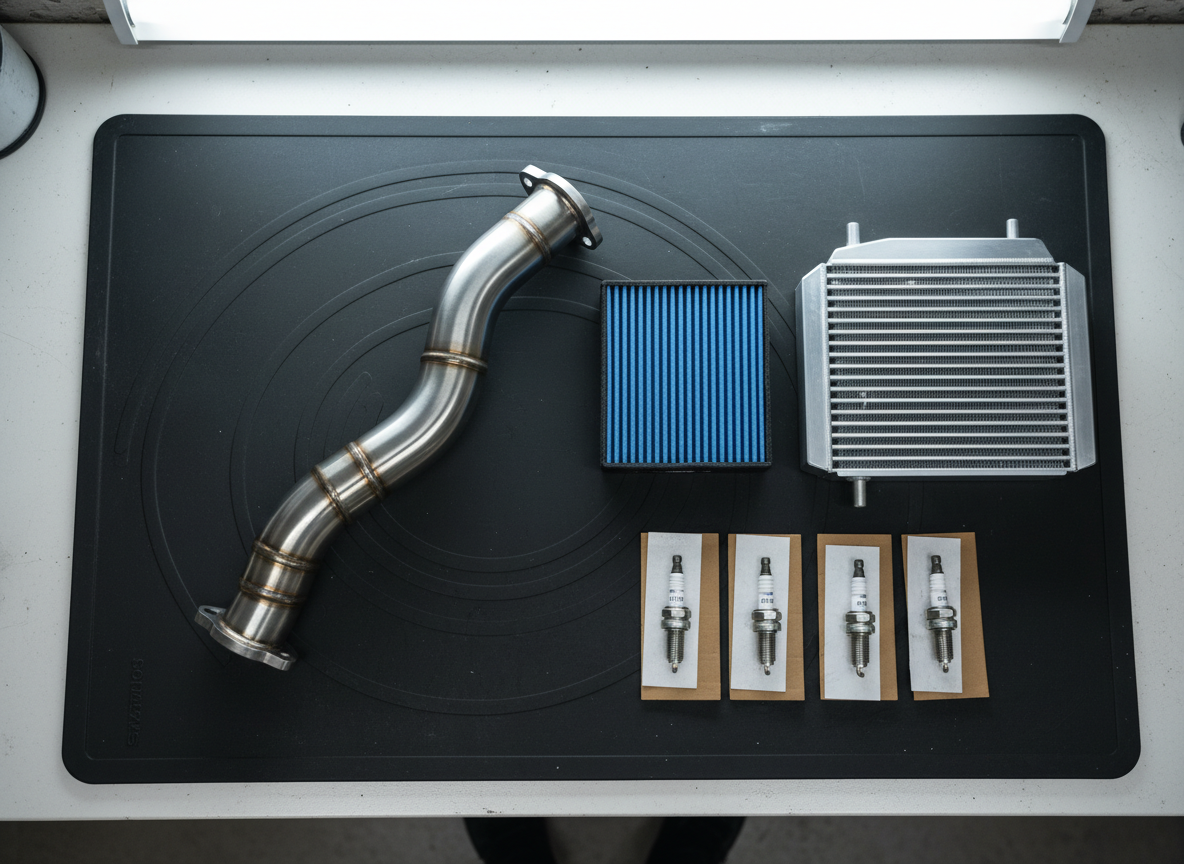
On remapped vehicles running higher boost, an upgraded intercooler is sometimes added to better manage intake temperatures at the higher power level. When a larger intercooler is fitted, the ECU map may need adjustment to account for the changed airflow characteristics — particularly on charge temperature compensation parameters.
Sensor fault misread
Boost pressure sensor faults, charge air temperature sensor failures, and MAF sensor issues can produce symptoms that mimic intercooler failure without any physical problem being present. A proper diagnostic will distinguish sensor-related faults from real hardware problems — and a software recalibration is sometimes needed if sensor parameters have been stored incorrectly in the ECU’s memory.
Diagnostics before spending
Before replacing the intercooler, a proper diagnostic scan and boost pressure test can identify exactly where the fault lies. Many customers save money by diagnosing correctly first — the intercooler is not always the cause of what looks like intercooler failure.
Next steps if you suspect a fault
If your diesel or turbocharged petrol is showing power loss, boost pressure faults, or smoke from the exhaust, the first step is a diagnostic assessment to identify what’s actually wrong.
- Don’t assume the worst: Symptoms that look like turbo or intercooler failure are often caused by a boost hose or clamp — a much cheaper fix.
- Get fault codes read: A proper OBD scan with live data will point you in the right direction before any parts are purchased.
- Address limp mode promptly: If the car has entered limp mode, avoid forcing the vehicle to work harder until the fault is diagnosed. Continued driving at high load with a boost leak can damage the turbocharger over time.
Suspect an intercooler or boost fault?
If power loss, boost faults, or limp mode are affecting your diesel or turbo petrol, a professional diagnostic assessment can pinpoint the real cause — whether it’s a boost hose, intercooler, sensor, or ECU issue.
Contact Leicester Remaps to arrange a diagnostic check across Leicester, Leicestershire, and the wider Midlands.