AdBlue Emulator vs Software Delete: Which Is Right for Your Vehicle?
When an AdBlue fault won’t clear, two workarounds often come up: a plug-in emulator box, or a software map-out of the SCR system at ECU level. Both stop the dashboard warnings and the no-start countdown — but they work very differently, and the choice between them has real consequences for reliability, detectability, and legal risk.
In this guide
Quick answer
An AdBlue emulator is a physical hardware module wired into your vehicle that sends synthetic “all OK” signals to the ECU, keeping it from triggering warnings or a no-start countdown. A software delete edits the ECU map directly so it stops monitoring the AdBlue system entirely. For vehicles where full ECU access is available, software is generally considered more stable long-term — but both are illegal on UK road-registered vehicles and will cause an MOT failure if discovered.
What is an AdBlue emulator?
An AdBlue emulator is a small electronic device that intercepts the signals between your AdBlue system components and the ECU. Rather than letting the ECU detect fault codes from a broken pump, empty tank, or failed NOx sensor, the emulator sends synthetic “healthy” readings — simulating tank level, pump pressure, temperature sensor data, and NOx sensor output.
From the ECU’s perspective, every part of the AdBlue system looks perfectly functional, even if the tank is empty and the SCR hardware is entirely disconnected. According to technical documentation from Canlogic, emulators operate by maintaining stable communication on the CAN bus — so the ECU never registers a fault and never triggers the warning sequence or mileage countdown.
Better-quality emulators connect via OEM-style adapter looms rather than spliced wiring, which makes them physically reversible — unplug the module, reconnect the original harness, and the vehicle returns to factory wiring.
When emulators are typically considered
Emulator boxes come up most often in agricultural, construction, and plant machinery — telehandlers, tractors, and HGVs that never go near an MOT bay. They’re also used on older Euro 5 vans where an ECU software solution isn’t available. On a road-registered UK vehicle, both the emulator and the software route carry the same legal risk.

What is an AdBlue software delete?
A software AdBlue delete — also called an SCR delete or ECU map-out — goes into the engine management system itself and disables AdBlue monitoring at the software level. The tuner reads the existing ECU file, modifies the calibration to remove the routines that check for AdBlue system status and generate fault codes, then writes the modified file back.
After a software delete, the ECU doesn’t look for AdBlue feedback, doesn’t log SCR-related faults, and doesn’t trigger the warning lights or no-start countdown — not because it’s receiving false signals from an emulator, but because it’s no longer checking for those signals at all.
This approach requires specialist ECU reading and writing equipment. Not all ECUs are accessible — some modern Euro 6 units with hardware encryption or security layers make software access significantly more complex. For a full overview of what’s involved in AdBlue fault diagnosis and what Leicester Remaps covers, see our AdBlue Solutions service page.
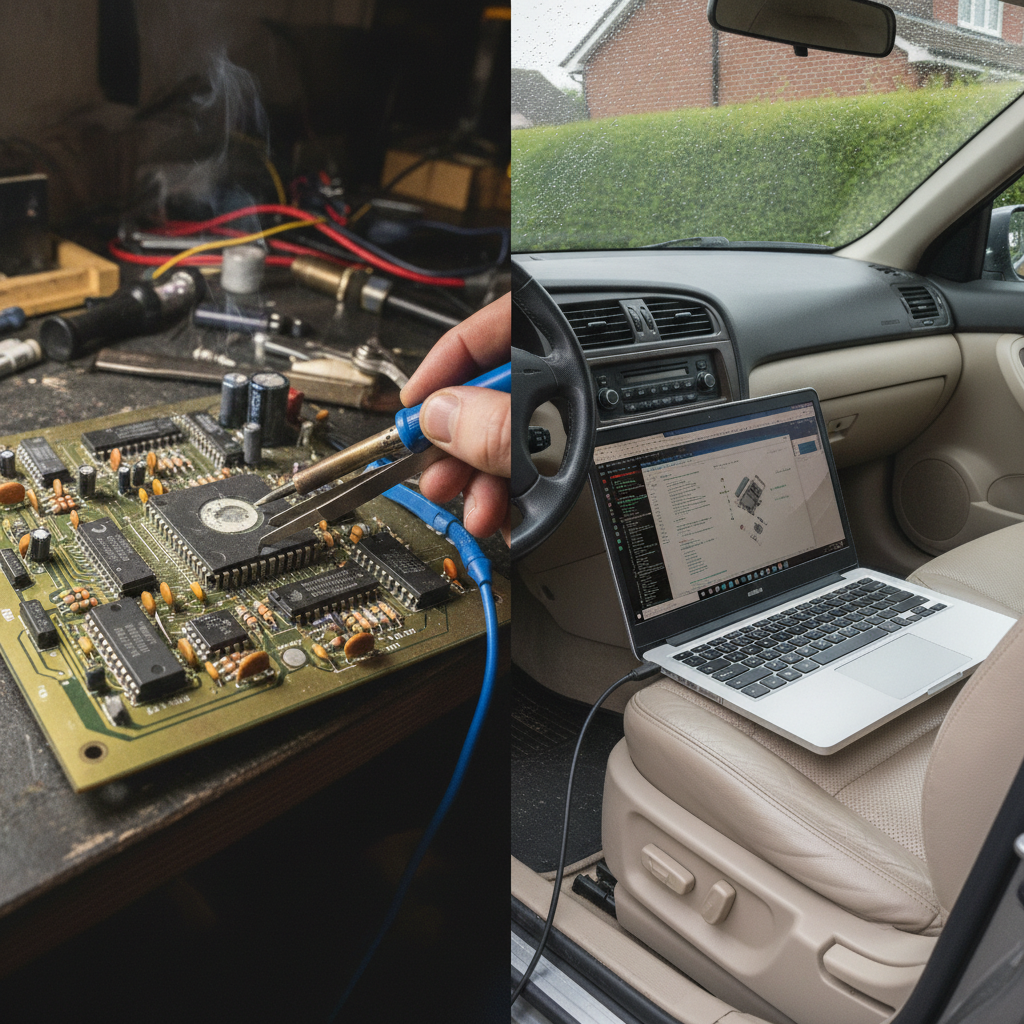
Emulator vs software: key differences compared
Both methods achieve the same end result for the driver — the warnings stop — but the mechanism, the reliability, and the practical implications differ meaningfully.
| Factor | Emulator box | Software (ECU) delete |
|---|---|---|
| How it works | Sends fake sensor signals to ECU via CAN bus | Removes AdBlue monitoring from ECU calibration |
| Physical hardware added | Yes — wired into vehicle loom | No — ECU edit only |
| Reversibility | Easier — unplug module, reconnect OEM wiring | Possible but requires a re-flash (original file must be saved) |
| Long-term stability | Dependent on wiring quality; module can fail | Generally more stable — no additional hardware to fault |
| Detectability | Increasingly flagged by dealer-level diagnostics | Not immediately visible; ECU file comparison required |
| Vehicle compatibility | Broader — some ECUs that can’t be read accept an emulator | Limited by ECU readability; encrypted units may not be accessible |
| UK road legality | Illegal on road-registered vehicles | Illegal on road-registered vehicles |
Which option suits which vehicle?
For most UK road vans, the practical choice comes down to what the ECU allows. On established Euro 5 platforms — Ford Transit, Mercedes Sprinter, VW Crafter — where ECU access is well-understood and tooling is mature, a software map-out is typically the cleaner, more reliable approach. It leaves no additional hardware in the vehicle, doesn’t add a failure point, and is harder to spot during a routine service.
According to analysis by Carhack, emulator boxes tend to be the better fit where ECU software access is restricted — certain encrypted Euro 6 units, agricultural machinery, and vehicles where tooling coverage is limited. In those cases, the emulator becomes the only practical option.
That said, it’s always worth establishing whether the AdBlue fault is a repairable hardware problem before looking at either workaround. A failed pump, cracked tank, or faulty sensor can often be repaired for less than the cost of a workaround — and repair leaves the vehicle fully road-legal with no MOT risk. iFixAdBlue’s comparison of AdBlue repair versus delete covers the cost breakdown across the most common fault scenarios.
What happens when diagnostics find an emulator
Dealer-level diagnostic equipment — and an increasing number of independent garages — can now identify emulator signals on modern vehicle protocols. When an emulator is discovered during a service or MOT preparation, the vehicle usually needs the emulator removed, the loom returned to factory standard, and the ECU fully interrogated before any meaningful diagnostic work can begin. That undoing process takes at least as long as the original fault diagnosis would have — meaning the customer pays twice for work that could have been avoided.

Legality and UK penalties
Both AdBlue emulators and software deletes are illegal on road-registered UK vehicles. Disabling or bypassing an AdBlue/SCR system constitutes emissions tampering under the Road Vehicles (Construction and Use) Regulations 1986, because the SCR system is an emissions control component that formed part of the vehicle’s original type approval.
In practical terms, a vehicle with either modification will fail its MOT. An emissions test will show NOx figures far above the type-approved values, and a tester who discovers a physical emulator can refuse the MOT on those grounds alone. DVSA guidance on emissions tampering sets potential penalties of up to £1,000 for a car and up to £2,500 for a van, lorry, or bus — in addition to any MOT refusal.
Insurance is a separate concern. Most insurers will not pay out on a claim if the vehicle is found to have an undisclosed modification that affected its roadworthiness. For a fuller breakdown of the legal risks, our posts on AdBlue delete disadvantages and risks and AdBlue delete legality in the UK cover both in depth.
Will diagnostics detect it?
Emulator detectability has increased substantially as diagnostic tooling has improved. Modern dealer-level systems — and increasingly, professional independent garages — can read CAN bus traffic and identify signal patterns that don’t match genuine SCR components. Older emulators that produced simple fixed-value signals are more easily flagged than newer units that attempt to simulate dynamic sensor behaviour, but the detection gap is narrowing.
A software delete is less immediately visible. Without comparing the ECU’s current calibration against a known-good baseline file, there’s nothing to read that overtly signals modification. However, an experienced ECU tuner or specialist garage with OEM diagnostic software can identify calibration anomalies that suggest the SCR routines have been removed — particularly if the fault codes associated with an SCR system simply never appear on a vehicle that should be generating them.
Frequently asked questions
What is an AdBlue emulator and how does it work?
An AdBlue emulator is a small electronic device wired into the vehicle’s loom that intercepts signals between the AdBlue system components — tank, pump, temperature sensors, NOx sensors — and the ECU. It sends synthetic “all healthy” readings back to the ECU, which sees no faults and triggers no warnings or no-start countdown, even if the physical AdBlue system is entirely absent.
Can an AdBlue emulator be detected at an MOT or service?
Increasingly, yes. Dealer-level diagnostic tools and modern professional equipment can flag emulator signals on the CAN bus. A physical emulator module is also visible under the bonnet to a thorough inspection. When one is found during a service or MOT preparation, the vehicle typically needs the emulator removed and the loom restored before any other work can proceed — adding significant cost.
Is an AdBlue emulator or software delete legal in the UK?
No. Both are illegal on road-registered UK vehicles. Disabling the AdBlue/SCR system by either method constitutes emissions tampering under the Road Vehicles (Construction and Use) Regulations 1986. Both will cause an MOT failure, and both can attract DVSA penalties — up to £1,000 for a car and up to £2,500 for a van or lorry. Insurance cover may also be void if a claim involves a vehicle with an undisclosed modification.
Is a software delete better than an AdBlue emulator?
On vehicles where the ECU can be read and written — which covers most Euro 5 diesels and many Euro 6 platforms — software is generally considered more stable, leaves no additional hardware to fault, and is harder to identify during routine servicing. The trade-off is that it’s less straightforwardly reversible than unplugging an emulator module. For vehicles where ECU access isn’t possible, an emulator may be the only practical alternative.
Have an AdBlue warning or no-start countdown?
Before looking at any workaround, it’s worth diagnosing whether the root cause is a repairable hardware fault — a failed pump or sensor is often cheaper to fix than the workaround itself, and keeps the vehicle fully road-legal with no MOT risk.
- Mobile diagnostic service across Leicester, Leicestershire and the wider Midlands
- AdBlue system diagnosis before any recommendation
- Honest assessment of the most cost-effective route for your specific vehicle
View our AdBlue Solutions service or get in touch to discuss your van or car.