ECU Chip Tuning vs ECU Remapping: What’s the Real Difference?
You’ve heard both terms — chip tuning and ECU remapping. They’re often used interchangeably online, but they describe different things. Understanding the difference matters if you’re researching how to tune your car and want to know what modern ECU remapping actually involves.
ECU remapping explained
Car tuning technology
Modern vs legacy methods
Jump to a section
What was ECU chip tuning?
Chip tuning was the standard method of modifying engine management systems from the 1980s through to the early 2000s. During that era, the ECU’s calibration data was stored on a physical EPROM chip — a programmable memory chip soldered onto the ECU circuit board.
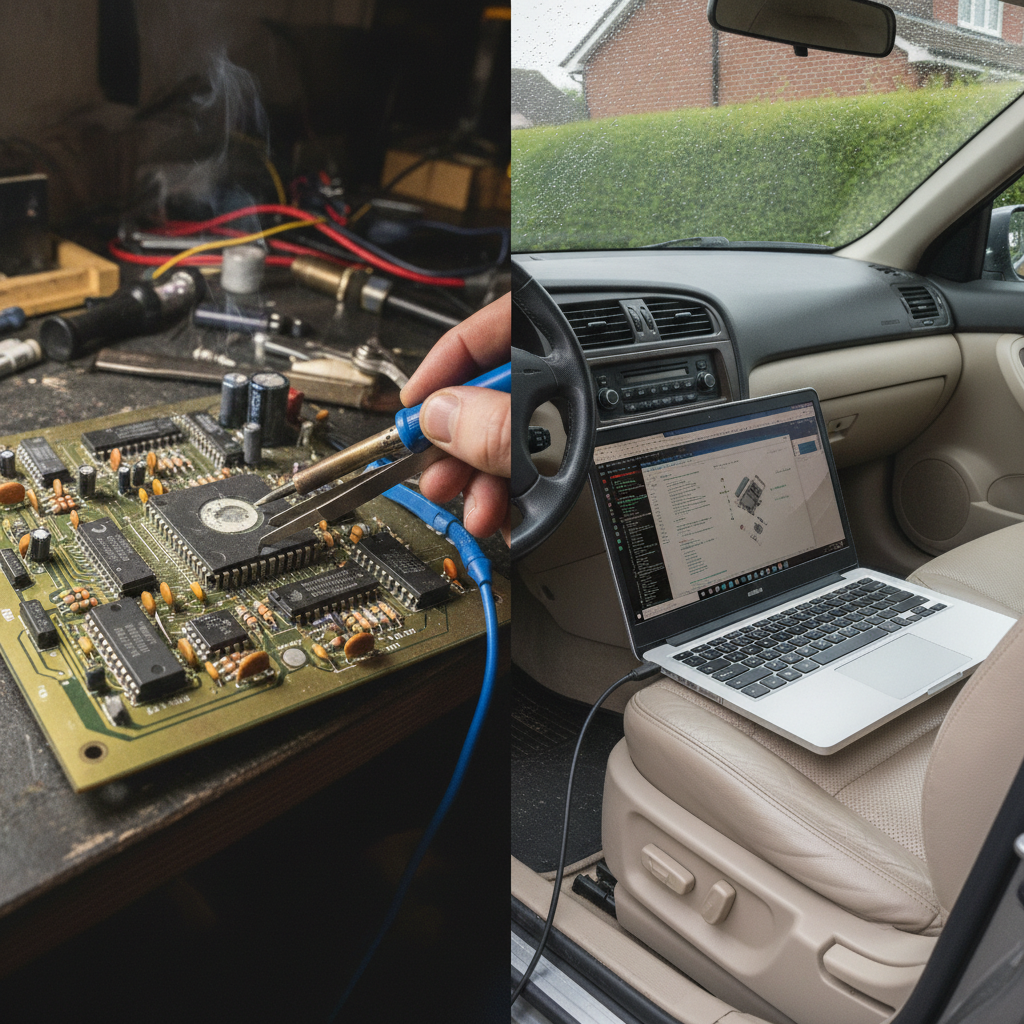
To change the engine’s behaviour, a tuner had to physically remove the ECU from the car, desolder the chip, replace it with a programmable equivalent (or an upgraded chip carrying a new map), and reinstall the unit. The process required specialist electronics skills and physically altered the hardware of the ECU.
Why chip tuning was the only option
Early ECUs had no external communication port that allowed map data to be read or written. The only way to modify the calibration was at hardware level — which is where the chip came in. Chip tuning was genuinely innovative at the time and produced real performance gains on the vehicles it could be applied to.
The original ECU chip-swap era
Popular cars for chip tuning in the 1990s included the Golf GTI Mk2/3, Peugeot 306 GTI-6, and various turbocharged Volvos. Specialist tuners could produce custom EPROM chips for specific engines, delivering real gains — but the process was time-consuming and required removing the ECU from the vehicle.
What is ECU remapping?
Modern ECU remapping is a software-based process. From the mid-2000s onwards, vehicle manufacturers began fitting ECUs with diagnostic communication ports — initially proprietary, later standardised as OBD (On-Board Diagnostics). These ports allow technicians to communicate with the ECU electronically.
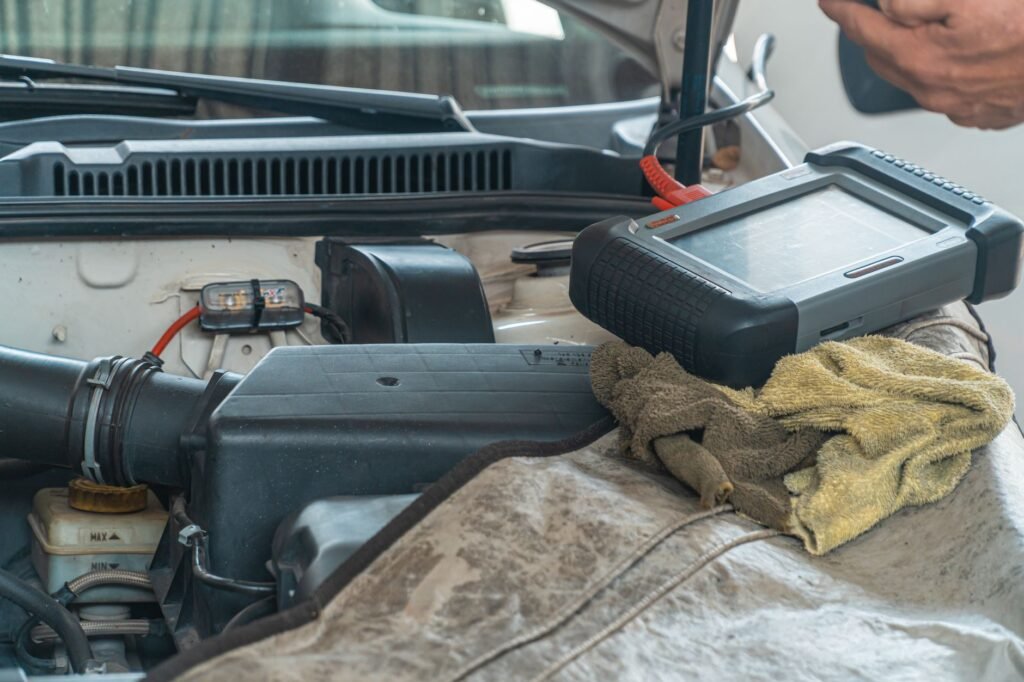
A modern remapper connects to the vehicle’s OBD port (or directly to the ECU in some cases using a bench connection) using specialist hardware and software. The existing calibration data — the “map” — is read from the ECU electronically, modified, and then written back. No physical chip is removed or replaced.
What the map contains
The ECU map is a collection of data tables and parameters that define how the engine responds under different conditions. These include:
- Boost pressure targets — how much boost the turbo should produce at different throttle positions and RPM.
- Fuelling maps — how much fuel is injected at each load and RPM point.
- Ignition timing — when the spark fires relative to piston position.
- Torque limiters — software limits that cap output at certain thresholds.
- Rev limiters and speed limiters — maximum RPM and vehicle speed caps.
A remapper adjusts these values to extract more performance, improve efficiency, or both — depending on the goal of the tune.

Key differences between chip tuning and ECU remapping
| Feature | Chip Tuning (Legacy) | ECU Remapping (Modern) |
|---|---|---|
| Method | Physical chip replacement | Software read/write via OBD or bench |
| ECU removal needed? | Yes — always | Usually no — OBD port connection |
| Reversible? | Requires new chip or re-soldering | Yes — original file stored and restoreable |
| Vehicle age | Pre-2000s cars mostly | 2000s onwards (most modern vehicles) |
| Time required | Half a day or more | 60–90 minutes typically |
| Suitable for | Classic, older, pre-OBD vehicles | Almost all modern cars and vans |
| Original file backup | No (physical replacement) | Yes — standard practice |
The most important practical difference is reversibility. A proper ECU remap backs up the original factory file before making any changes. If you sell the car, need to return to standard, or want the remap removed for any reason, the original map can be restored. Chip tuning didn’t offer that safety net — once the chip was swapped, reverting meant finding the original chip or getting a new one burned.
When people say “chip tuning” today
Many modern workshops and online services still use the term “chip tuning” — but they’re describing ECU remapping, not physical chip replacement. If someone is offering “chip tuning” for a car made after 2000, they’re almost certainly doing an OBD flash remap. The name has stuck, but the method has changed completely.
Which cars can be remapped vs chip tuned?
For most cars on UK roads today — anything made from roughly 2000 onwards — ECU remapping via OBD or bench is the correct approach. Chip tuning in the traditional sense is relevant for older classic cars and pre-OBD vehicles where the ECU physically requires a chip to be replaced.
A small number of modern ECUs are encrypted or locked by the manufacturer, which requires bench programming rather than OBD connection. This is more involved than a standard OBD remap but is still a software process — no chip is physically replaced.
Vehicles that may still require bench work
- Some newer BMW, Mercedes, and VAG group vehicles with encrypted ECUs.
- Certain Fiat, Alfa Romeo, and PSA platform vehicles where the OBD interface is restricted.
- Vehicles where the OBD protocol has been deliberately locked by the dealer.
Bench remapping involves removing the ECU and connecting directly to it in a bench environment. The result is still a software map change — the hardware is not physically modified. It’s more labour-intensive but produces the same result as an OBD remap.

What about tuning boxes?
Tuning boxes are a third option that is different from both chip tuning and ECU remapping. A tuning box is a plug-in device that intercepts signals between the ECU and the injectors or sensors, modifying them in real time to fool the engine management system into delivering more fuel or boost.
They are not a map change. The ECU itself is not modified — the box is working around it. Tuning boxes can produce some power gains, but they don’t interact with the full range of ECU parameters and can produce inconsistent results across the rev range. A genuine ECU remap — writing directly to the ECU’s calibration — is a more comprehensive and precise process.
A tuning box is also easier for a dealer to identify on a vehicle inspection because it’s a physical device plugged in. A properly done ECU remap, stored within the ECU’s memory, is not identifiable without specialist reading equipment.
What to ask when choosing a remapper
Whether someone calls it “chip tuning” or “ECU remapping”, the process and quality depend on the person doing the work. Key questions to ask:
- Do you read the original file before writing a new map? A yes confirms they’re doing a genuine remap, not applying a generic file without reading the vehicle first.
- Do you back up the original ECU file? This should always be yes. The backup is your protection.
- What equipment do you use? Professional remapping hardware from reputable tool manufacturers is a positive sign. Vague answers aren’t.
- Is this a custom calibration or a generic map? A custom map adjusted to your specific vehicle will always produce better results than a one-size-fits-all file.
- Do you do a pre-remap health check? Remapping a car with existing fault codes or mechanical issues is bad practice. A health check should happen before the map is written.
Modern ECU remapping in Leicester
Leicester Remaps provides mobile ECU remapping for cars and vans across Leicester, Leicestershire, and the wider Midlands. Every remap starts with reading the original ECU file, running a pre-remap health check, and producing a custom calibration — not a generic file from a shared database.
The original file is always backed up before changes are written. The vehicle can always be returned to standard.
Interested in an ECU remap?
Whether you’re looking for performance, fuel economy, or a combination of both, get in touch to discuss what’s achievable for your specific vehicle.
Learn about Stage 1 remapping or contact Leicester Remaps to book a mobile remap at your location.