ECU Remapping for Daily Drivers: What Actually Changes?
If you use your car every day, ECU remapping is not about chasing headline power figures.
It is about how the car feels in normal driving. Pulling away from junctions. Overtaking without stress.
Cruising without constant gear changes. This guide explains what actually changes after an ECU remap,
with a focus on real-world daily driving across Leicester and the Midlands.
What ECU Remapping Means for a Daily Driver
ECU remapping involves adjusting the software inside your car’s engine control unit.
This software controls fuel delivery, boost pressure, ignition timing, torque limits,
throttle response, and many other parameters that shape how your car drives.
From the factory, most cars are tuned to suit a wide range of conditions.
Different fuel quality. Hot and cold climates. Varying driver habits.
The result is a conservative setup that works everywhere, but rarely feels optimised for everyday UK driving.
A well-written remap focuses on refining these settings so the engine responds more naturally.
For daily drivers, this means smoother power delivery, stronger mid-range torque,
and less effort required to make progress in traffic.
Throttle Response: The First Change Most Drivers Notice
One of the biggest complaints with modern cars is delayed throttle response.
You press the pedal, wait a moment, then the car finally reacts.
This is common on turbocharged petrol and diesel engines.
Manufacturers often soften throttle mapping to improve emissions figures and driveline comfort.
The downside is a disconnected feel between your right foot and the engine.
After an ECU remap, throttle response becomes more direct.
The car reacts sooner and more predictably to pedal input.
This does not make the car aggressive or jerky.
It makes it feel more natural and easier to control at low speeds.
In everyday driving, this means:
- Smoother pull-away from junctions
- Less hesitation in stop-start traffic
- More confidence when merging onto busy roads
Torque Delivery: Why the Car Feels Stronger Without Being Faster
Torque is what you feel when the car accelerates without needing high revs.
For daily drivers, torque matters more than peak power.
A Stage 1 ECU remap typically increases torque lower down the rev range.
Instead of needing to rev the engine hard, the car pulls more cleanly from lower speeds.
This is why many drivers say their car feels “lighter” or “easier” to drive after a remap.
The engine does not work as hard to achieve the same result.
In practical terms, stronger torque means:
- Fewer gear changes in town
- Less downshifting on hills
- More relaxed overtakes on A-roads
For drivers in Leicester and surrounding areas, this makes a noticeable difference on mixed routes,
where traffic, roundabouts, and short bursts of acceleration are common.
Mid-Range Pull: Where Daily Driving Lives
Most daily driving happens in the mid-range.
Between 1,800 and 3,500 RPM for diesels.
Between 2,000 and 4,000 RPM for many petrol cars.
Factory tuning often leaves this area underdeveloped.
Power may be available higher up, but rarely used in normal conditions.
ECU remapping reshapes the torque curve so more usable power is available where you actually drive.
This improves flexibility and reduces the need to plan every manoeuvre in advance.
Drivers often notice this most in third gear.
The car pulls cleanly without hesitation, making everyday progress smoother and less tiring.
Gear Changes and Driveability
Improved torque and throttle response have a knock-on effect on gear changes.
Even on manual cars, shifts feel cleaner because the engine responds more consistently.
On automatic and DSG-style gearboxes, smoother torque delivery helps the gearbox make better decisions.
The car is less likely to hunt between gears or hold revs unnecessarily.
For daily drivers, this results in:
- Smoother low-speed manoeuvring
- More predictable acceleration
- Less strain during urban driving
Fuel Economy: Why Some Drivers See Improvements
Fuel economy is a common question when discussing ECU remapping for daily use.
A remap does not magically reduce fuel consumption.
It changes how efficiently the engine delivers power.
Because torque is available earlier, drivers often use less throttle to achieve the same speed.
This can lead to modest fuel savings during steady driving.
Improvements are more likely on:
- Motorway cruising
- A-road commuting
- Light-load urban driving
Aggressive driving will still use more fuel.
The benefit comes from reduced effort, not restraint forced by the software.
Noise, Vibration, and Smoothness
Daily drivers need refinement.
No one wants a car that feels harsh or noisy on a long commute.
A properly written ECU remap improves smoothness by reducing flat spots and uneven power delivery.
The engine operates more consistently across the rev range.
This can reduce vibration during acceleration and make cruising feel calmer.
Especially on diesel engines, smoother torque delivery often results in a quieter driving experience.
Cold Starts and Short Journeys
Many daily drivers cover short distances.
School runs. Local errands. Urban commuting.
ECU remapping does not remove warm-up strategies or safety limits.
Cold start behaviour remains controlled to protect the engine.
What often improves is drivability once the car begins moving.
Less hesitation. More predictable response.
This makes short journeys less frustrating.
Does a Remap Change How the Car Feels in Traffic?
Yes, and this is where daily drivers benefit the most.
Stop-start traffic exposes poor throttle mapping and weak low-end torque.
After a remap, the car feels easier to modulate at low speeds.
Crawling traffic becomes smoother.
Pulling away feels more controlled.
The car reacts when you expect it to.
Mobile ECU Remapping for Daily Drivers in Leicester
For many drivers, convenience matters as much as performance.
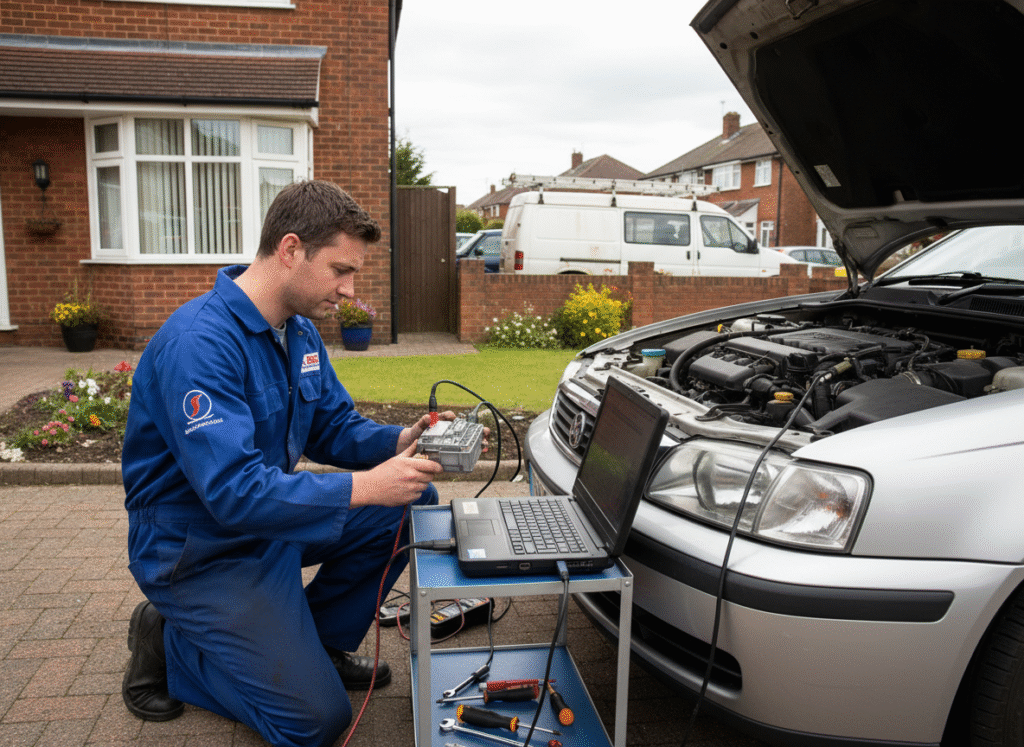
Mobile ECU remapping allows the work to be carried out at your home or workplace.
There is no need to take time off or arrange alternative transport.
A typical mobile Stage 1 remap takes around an hour.
The ECU is read, a custom file is written for your vehicle, and the software is installed on-site.
This approach suits daily drivers who rely on their car and want minimal disruption.
Is ECU Remapping Suitable for High-Mileage Daily Cars?
Mileage alone does not determine suitability.
What matters is condition.
A well-maintained car with higher mileage can respond just as well as a newer vehicle.
Before remapping, basic health checks and diagnostics should always be carried out.
This ensures the engine and supporting systems are operating as expected.
For daily drivers, this careful approach keeps reliability front and centre.
What Does Not Change After a Remap
It is important to set realistic expectations.
ECU remapping does not:
- Turn a car into a race vehicle
- Remove the need for servicing
- Fix mechanical faults
What it does is refine how the engine behaves within safe limits,
improving the driving experience you already have.
Is ECU Remapping Worth It for Everyday Use?
For many drivers, the answer is yes.
The biggest benefits are not headline figures.
They are the small, constant improvements you notice every time you drive.
Easier acceleration.
Smoother progress.
Less effort behind the wheel.
These changes add up over thousands of miles.
Speak to a Local ECU Remapping Specialist
If you drive daily and want a car that feels more responsive and easier to live with,
ECU remapping can make a genuine difference.
Leicester Remaps provides mobile ECU remapping across Leicester and the wider Midlands.
Each remap is tailored to the vehicle and the way it is used.
To find out how a remap would change your day-to-day driving,
get in touch and discuss your car with a specialist.