Stage 1 Remap for Towing: What to Expect
Towing puts very different demands on a vehicle compared to normal driving.
Whether you are pulling a caravan, trailer, horsebox, or work equipment,
the extra weight quickly exposes weak low-rev torque and strained throttle response.
This guide explains what a Stage 1 remap actually changes for towing,
what improvements drivers notice day to day,
and what to expect from a properly set-up towing remap.
Why Towing Feels So Hard on Standard Vehicles
Most factory engine calibrations are designed for emissions compliance and light-load driving.
They are not optimised for sustained load at low to mid engine speeds.
When you tow, the engine has to work harder in the exact rev range
where manufacturers often restrict torque.
This leads to:
- Sluggish pull-away
- Frequent gear changes
- Strain on hills
- Higher exhaust temperatures
- Driver fatigue on long journeys
A Stage 1 remap focuses on addressing these weak points without altering hardware.
What a Stage 1 Remap Actually Changes
A Stage 1 remap adjusts the software inside the engine control unit.
It does not involve fitting parts or modifying the engine mechanically.
For towing, the most important changes are:
- Torque delivery at low and mid RPM
- Throttle response under load
- Turbo control and boost response
- Fuel delivery calibration
- Torque limiters used during sustained load
The goal is usable strength, not headline power figures.
Low-RPM Torque: The Biggest Difference When Towing
Towing is all about torque.
Peak horsepower figures mean very little when pulling weight from low speeds.
A Stage 1 remap reshapes the torque curve so more pulling power is available
earlier in the rev range.
Drivers typically notice:
- Smoother pull-away with less throttle
- Stronger response between 1,500–2,500 rpm
- Reduced need to rev the engine
- Less clutch slip on hills
This alone makes towing feel far more controlled.
Hill Starts and Inclines
Hill starts are one of the most stressful parts of towing.
On a standard vehicle, drivers often compensate by:
- Over-revving the engine
- Slipping the clutch excessively
- Riding the throttle
With improved low-end torque, the engine does more of the work.
This reduces strain on the clutch and improves confidence.
Gearbox Behaviour While Towing
Towing often highlights poor gearbox behaviour.
Manual gearboxes may feel like they constantly need downshifting.
Automatic gearboxes may hunt between gears.
By increasing torque in the working range,
a Stage 1 remap allows the gearbox to:
- Hold higher gears for longer
- Reduce unnecessary downshifts
- Maintain speed more easily on inclines
This improves smoothness and reduces heat build-up in the drivetrain.
Throttle Control and Smoothness
Standard throttle maps are often aggressive to mask low torque.
When towing, this can cause jerky acceleration,
especially at low speeds or in traffic.
A well-written Stage 1 remap refines throttle behaviour so:
- Power delivery feels progressive
- Small pedal inputs give predictable response
- Low-speed manoeuvring is easier
This matters when reversing trailers or navigating tight spaces.
Does a Stage 1 Remap Increase Towing Capacity?
No.
A remap does not change the manufacturer’s legal towing limits.
These are set by chassis, brakes, cooling, and homologation.
What it does change is how comfortably and confidently
the vehicle operates within those limits.
Fuel Economy While Towing
Towing will always use more fuel.
A remap does not change that reality.
However, improved torque efficiency often means:
- Less throttle required to maintain speed
- Fewer high-RPM runs
- Reduced gear changes
Many drivers report similar or slightly improved fuel consumption
compared to stock when towing the same load.
Engine and Thermal Load Considerations
A common concern is whether towing with a remap increases engine stress.
In practice, a correctly calibrated Stage 1 remap can reduce stress by:
- Lowering the need for constant high revs
- Reducing exhaust gas temperatures under load
- Improving combustion efficiency
The key is staying within safe limits and avoiding aggressive peak figures.
Diesel vs Petrol for Towing Remaps
Diesel engines respond particularly well to towing-focused remaps.
Their natural torque characteristics suit load-based driving.
A Stage 1 diesel remap often transforms towing behaviour.
Petrol engines also benefit,
but gains are usually felt higher in the rev range.
The improvement is still noticeable, just different in character.
Is a Stage 1 Remap Suitable for Regular Towing?
Yes, provided the vehicle is healthy and maintained correctly.
A towing-focused remap should prioritise:
- Torque spread over peak output
- Thermal safety
- Drivetrain protection
- Predictable delivery
This makes it suitable for frequent towing, not just occasional use.
Checks Before Remapping a Tow Vehicle
Before applying a Stage 1 remap, the vehicle should be checked for:
- Clutch condition
- Cooling system health
- Fault codes
- Service history
Towing already places extra demand on components.
A remap should only be done on a sound base vehicle.
Why Stage 1 Is Usually the Right Choice for Towing
Stage 1 tuning works within the limits of standard hardware.
This makes it ideal for towing vehicles that need:
- Reliability
- Predictable performance
- Minimal mechanical risk
More aggressive stages are rarely necessary for towing
and can introduce unwanted trade-offs.
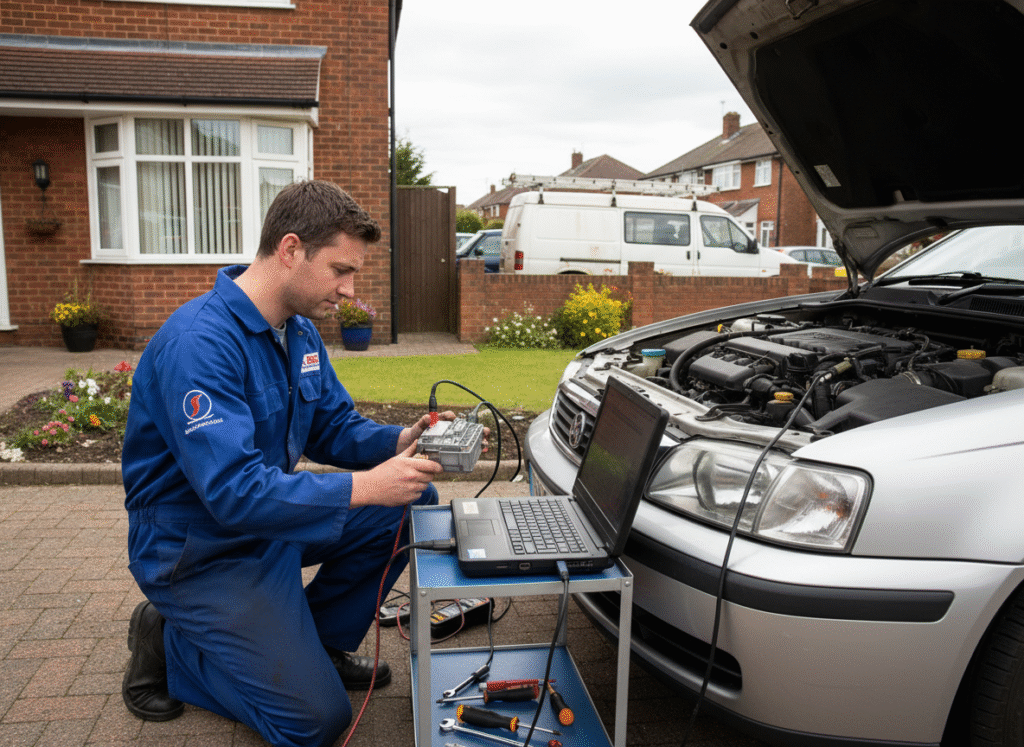
Mobile Stage 1 Remaps for Towing in Leicester
Mobile remapping allows towing vehicles to be tuned
without unhooking trailers or disrupting schedules.
The remap can be carried out at home or at work,
with real-world testing in the conditions the vehicle actually sees.
This makes it particularly practical for caravans,
horseboxes, and work trailers.
What Drivers Usually Notice First
After a Stage 1 towing remap, drivers commonly report:
- More relaxed driving
- Better control on hills
- Less engine noise under load
- Improved confidence when overtaking
These changes make long towing journeys far less tiring.
Final Thoughts
Towing exposes the weaknesses of factory engine calibration.
A well-set-up Stage 1 remap addresses those weaknesses
by improving torque, control, and drivability.
It does not turn a vehicle into something it is not.
It simply allows it to do its job more comfortably and efficiently.
For drivers who tow regularly,
it is one of the most noticeable and practical upgrades available.