
EGR Fault Codes Explained: P0401, P0402, P0403 and P0404 on Modern Diesels
Four codes, two completely different problems. P0401 and P0402 are about how much exhaust gas is actually moving. P0403 and P0404 are about wiring and position feedback. Read them in the wrong order and you end up buying a valve you never needed.
EGR System
OBD Fault Codes
Leicestershire Mobile Service
The short answer
EGR fault codes P0401 and P0402 describe exhaust gas flow — too little and too much respectively. P0403 and P0404 describe the control circuit and the valve position signal, not flow at all. Diagnose flow codes by inspecting for soot blockage first, and circuit codes by testing wiring and the position sensor.
What the P04xx Family Is Actually Telling You
Before you can act on any EGR fault code, it helps to know what the valve is there to do. Exhaust gas recirculation feeds a measured amount of spent exhaust back into the intake. That gas is inert, so it displaces oxygen and soaks up heat. EGR reduces oxides of nitrogen by lowering the oxygen concentration in the combustion chamber and through heat absorption — that is the entire point of the system.
The quantities involved are not trivial. On a turbocharged diesel with a fixed geometry turbo, up to 45–50% of exhaust gas can be recirculated at certain operating points without a major effect on fuel consumption. That is a lot of hot, sooty gas passing through a valve and a set of narrow passages, several hundred times a minute, for the life of the engine.
Which is why the codes split into two groups. The ECU has two separate ways of checking the system, and each one raises its own family of faults.
Flow codes: P0401 and P0402
These are calculated, not measured directly. The ECU commands a valve position, then watches what happens to the mass airflow reading, the manifold pressure, or both. If the expected change does not arrive, it logs insufficient flow. If the change is larger than commanded, it logs excessive flow.
Circuit codes: P0403 and P0404
These come from the electrical side. The ECU is either failing to drive the actuator, or the position feedback it gets back does not agree with the position it asked for. Neither code says anything at all about how much gas is moving.
What most guides get wrong
Search any of these codes and you will be told to replace the EGR valve. On a modern diesel that is the wrong default. A flow code is far more often a passage packed with carbon than a valve that has stopped working, and a circuit code is an electrical fault that a new valve may not fix at all.
P0401 — Exhaust Gas Recirculation Flow Insufficient
P0401 means the ECU asked for recirculated gas and did not see enough of it arrive. It is the most common code in the family on high-mileage diesels, and on most vehicles it appears gradually rather than overnight.
What it usually is
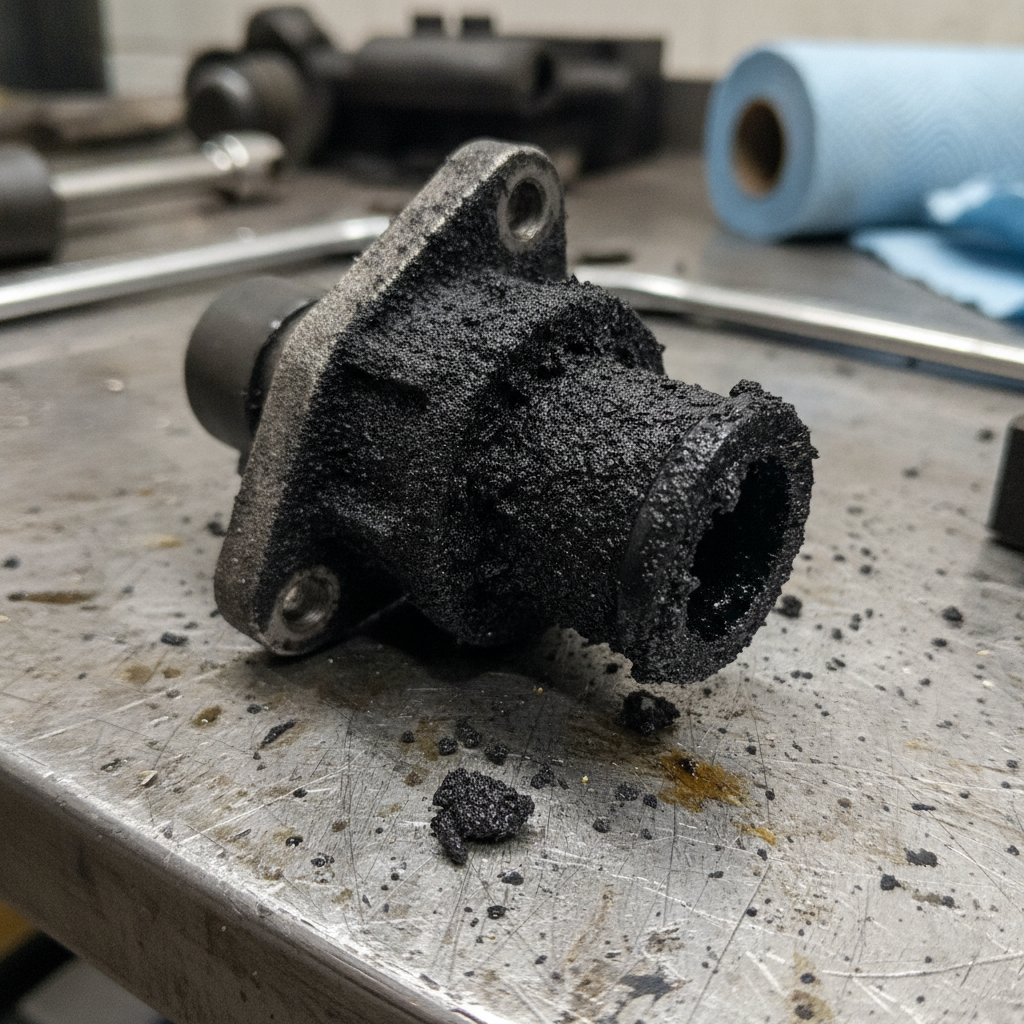
Carbon. Soot builds in the valve seat, in the EGR pipe between the manifold and the intake, and in the cooler matrix. The valve can be opening perfectly and still deliver almost nothing, because the route is silted up. This is why a valve replacement sometimes fixes a P0401 for three months and then the code returns — the new valve was fitted to the same blocked pipe.
What else it can be
- A differential pressure or delta-P sensor reading incorrectly, so the ECU cannot verify flow it is actually getting
- Blocked or perished vacuum lines on older vacuum-actuated systems
- A cooler that has partially collapsed or coked internally
- An intake manifold that is restricted enough to change the pressure differential across the valve
How it feels to drive
Often, barely different. A P0401 on its own frequently produces nothing more than an engine management light. Where it does affect the car, the symptoms are a slightly rougher idle, a small drop in low-end response, and occasionally a failed regeneration cycle on the particulate filter because exhaust temperatures are not sitting where the strategy expects them.
The carbon that causes P0401 does not appear in isolation, either. It is the same deposit process described in our guide to how carbon builds up inside a modern diesel engine, and the driving pattern that causes one usually causes the other.
P0402 — Exhaust Gas Recirculation Flow Excessive
P0402 is the mirror image and it is the more disruptive of the two. The ECU is seeing more recirculated gas than it commanded, which almost always means the valve is not closing when it should.
Why a stuck-open valve is worse
Recirculated exhaust displaces oxygen. That is fine at light load, which is when the ECU wants it. Under acceleration it is the opposite of what the engine needs, so a valve stuck open produces hesitation, black smoke under load, poor throttle response and, on some strategies, limp mode.
Common causes
- Carbon holding the valve off its seat — the same deposits that cause P0401, sitting in a different place
- A failed return spring or seized actuator shaft
- A cracked or leaking EGR cooler allowing an uncommanded path
- A position sensor reporting closed when the valve is not
Do not ignore a P0402 on a working vehicle
Excessive recirculation at load raises soot production sharply. On a van doing daily miles, an unresolved P0402 tends to be followed within weeks by particulate filter complaints that cost considerably more to put right than the original valve fault.
P0403 — EGR Control Circuit Malfunction
P0403 is an electrical fault. The ECU has detected that the circuit driving the EGR actuator is open, shorted, or outside its expected resistance. The valve itself may be in perfect condition.
Where to look
- The connector at the valve — heat, vibration and oil mist make this a common failure point
- Chafed loom sections where the harness passes a bracket or the engine cover
- A failed solenoid or actuator motor winding
- Corroded or pushed-back pins, particularly on vehicles that have had a previous valve replacement
- Less often, a driver fault inside the ECU itself
The distinguishing feature of P0403 is that it can be present with a physically spotless valve. If you have a P0403 and no flow code alongside it, the gas path is probably fine and the problem is between the ECU and the actuator.
P0404 — EGR Control Circuit Range or Performance
P0404 sits between the two groups and it is the one most often misread. The circuit is intact — that is what separates it from P0403 — but the position the ECU commanded and the position reported back do not match closely enough.
Three ways that happens
- Mechanical binding. The valve is sticky with deposits, so it moves more slowly than the ECU expects and the feedback lags outside tolerance.
- Sensor drift. The position sensor is reporting a plausible but wrong figure, often because the potentiometer track has worn.
- Partial obstruction. The valve physically cannot reach the commanded position because carbon is limiting its travel.
A P0404 arriving alongside a P0401 is a strong pointer. It means the ECU can see both that flow is short and that the valve is not sitting where it was told to sit — which usually confirms a mechanical restriction rather than a sensor problem.
Reading Two Codes Together
Single codes are ambiguous. Combinations are not. This is the pattern we work to on the roadside before anything is removed from the vehicle.
| Codes present | Most likely cause | First check |
|---|---|---|
| P0401 alone | Carbon restriction in valve, pipe or cooler | Live flow data, then inspect the EGR pipe rather than the valve |
| P0401 + P0404 | Valve travel physically limited by deposits | Commanded versus actual position under load |
| P0402 alone | Valve held or stuck off its seat | Actuator return with the engine off, then cooler integrity |
| P0403 alone | Wiring, connector or actuator winding | Continuity and resistance at the valve connector |
| P0404 alone | Position sensor drift | Sensor sweep across the full range |
| Flow code plus intake pressure codes | Shared restriction upstream of the valve | Manifold and intake tract before condemning the EGR |
The order matters because the cheap checks eliminate the expensive causes. Continuity testing a connector takes minutes. Removing a manifold does not.
What Actually Clears an EGR Code
Clearing the fault memory is not a repair. The ECU will re-run its monitor on the next drive cycle and, if the underlying condition is still there, the code returns. Here is what genuinely resolves each type.
For flow codes
Physical decarbonising of the valve, the pipe and the cooler where fitted. On some engines the valve can be cleaned in place; on others it has to come off. The critical point is that the whole path is cleared, not just the component that was easiest to reach.
For circuit codes
Repair or replacement of the wiring, connector or actuator. A new valve fixes this only when the actuator itself is the failed part.
Where software comes into it
Some owners in Leicestershire choose to have the EGR strategy addressed in the ECU rather than repeatedly cleaning a system that keeps silting up — particularly on vehicles doing short, cold journeys where deposits reform quickly. That is a separate decision with its own scope, and we cover what it does and does not include in our guide to what an EGR software change covers on its own, and in more general terms in our overview of common EGR valve problems on modern diesels.
Whichever route makes sense, it starts with reading the codes correctly. Our EGR work across Leicester and the surrounding county begins with live data on the vehicle, not with a parts order.
Frequently Asked Questions
Can I drive with a P0401 code?
Usually yes, in the short term. P0401 on its own rarely triggers limp mode and the vehicle typically drives normally. It should still be investigated, because the restriction causing it tends to worsen and can start affecting particulate filter behaviour.
Will cleaning the EGR valve clear P0401?
Sometimes, but only if the valve was the restriction. If the EGR pipe or cooler is where the blockage sits, a cleaned valve will pass its own inspection and the code will return within a few hundred miles. Clean the whole path or you are guessing.
What is the difference between P0401 and P0402?
P0401 means too little recirculated gas is reaching the intake. P0402 means too much is. They can share a root cause — carbon — but they usually need different work, and P0402 is the one more likely to affect how the vehicle drives.
Does a P0404 mean the EGR valve has failed?
Not necessarily. P0404 means the reported valve position does not match the commanded position. That can be a worn position sensor, a valve stiff with deposits, or a valve unable to complete its travel. Only one of those three is a failed valve.
Why do EGR codes come back after the valve is replaced?
Because the new valve was fitted into an unchanged system. If the pipe, cooler or intake tract is still restricted, the ECU will still fail to see the flow it expects and will log the same code against a brand new part.
Get Your EGR Codes Read Properly — Across Leicestershire
If your diagnostic reader is showing a P0401, P0402, P0403 or P0404, the useful next step is live data on the vehicle rather than a guess at a part. We come to you.
- Mobile diesel diagnostics at your home or workplace
- Commanded versus actual EGR position checked under load, not just at idle
- Honest answer on whether it is carbon, wiring or a genuine component failure
- Covering Leicester, Loughborough, Hinckley, Coalville, Melton Mowbray, Market Harborough and the wider county — we are a mobile service, so there is no workshop to drive to
Call or message 07849 475153, or get in touch here and tell us the codes you are seeing.